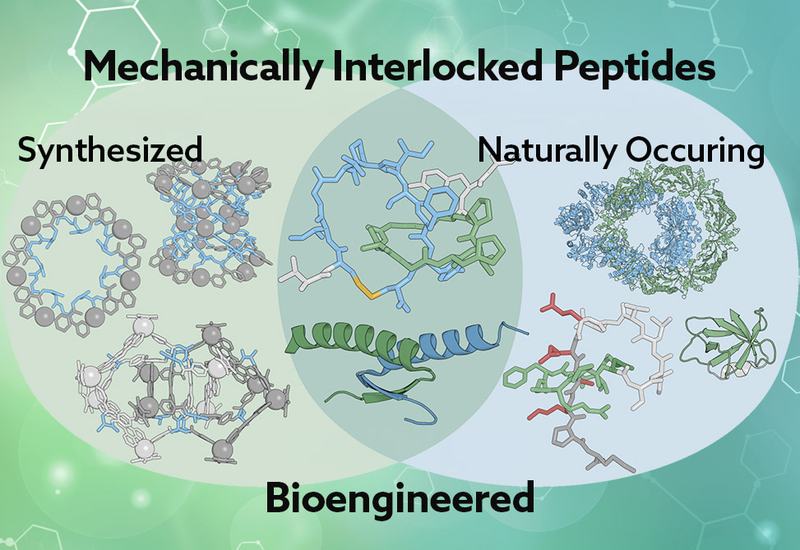
Mechanically interlocked molecules, MIMs, were first synthesized in the 1960s as curiosities with no obvious function, yet nature had already been building them for billions of years. Catenated DNA regulates transcription, the HK97 bacteriophage assembles a [72]catenane capsid from 420 protein subunits, and lasso peptides have a C-terminal tail threaded through a macrolactam ring to create [1]rotaxane natural products that survive boiling and autoclaving. Biologists studying these structures and chemists designing synthetic analogs have operated largely in isolation, hindered by incompatible nomenclature: biologists apply "topology" to structures that are, by any rigorous mathematical definition, topologically trivial, while supramolecular chemists have rarely engaged with the rich biological precedent that genome mining continues to surface. The result is a field whose full potential remains locked behind a language barrier.
Researchers in the Link Group at Princeton University, published in the Journal of the American Chemical Society, address this disconnect with a systematic perspective spanning every class of mechanically interlocked peptide, MIP, currently known. The authors begin by grounding the field in knot theory, clarifying which architectures are topologically complex, knots and catenanes, which cannot be represented in two dimensions without crossing points, and which are topologically trivial, and rotaxanes and entanglements, which can. Applying these distinctions, they survey naturally occurring MIPs from the seven-residue macrocycle of the smallest lasso peptides to the Möbius topology of cyclotide cysteine knots to higher-order protein catenanes stabilized by disulfide bridges. They then trace the parallel history of synthetic MIMs containing amino acids, from metal-ion-templated trefoil knots whose crossing pattern is governed by amino acid stereochemistry to peptide catenanes assembled via the hydrophobic effect in water. A key mechanistic thread runs through both worlds: the amino acid stereogenic center actively directs topological chirality, ring-closing diastereoselectivity, and, in bioengineered systems, the preferred coconformer of a molecular shuttle.
By drawing direct chemical comparisons between biological and synthetic MIPs, the perspective maps the opportunities that bioengineering technologies offer for screening mechanically interlocked scaffolds with tailored biological activity. Two FDA-approved cysteine-knot drugs and a growing pipeline of lasso peptide leads underscore the therapeutic stakes. Readers seeking the full taxonomic framework, the unified nomenclature proposals, and the authors' forward-looking analysis of biocompatible molecular machines will find them in the original publication.